
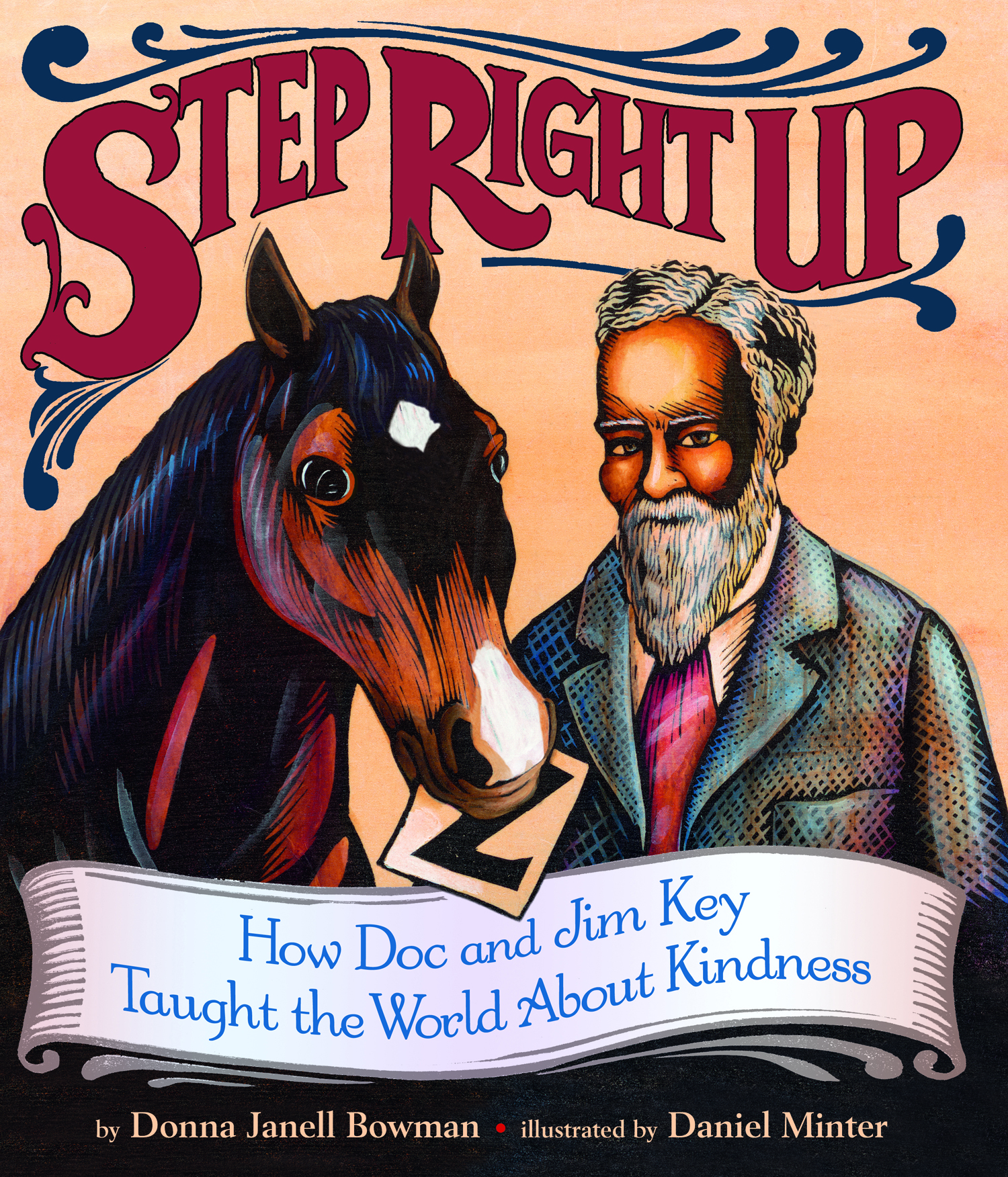
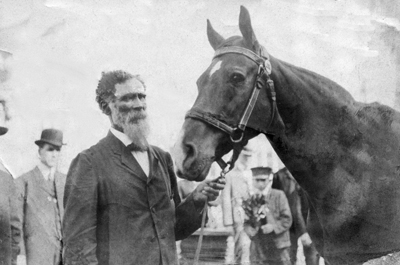
The most difficult part of writing a nonfiction picture book is deciding what to leave out of a space-constrained narrative. In Step Right Up: How Doc and Jim Key Taught the World About Kindness, it was especially painful to leave out amazing anecdotes and details. At almost every school visit presentation about the book, kids almost always ask for deleted or omitted nuggets of awesomeness, so I decided to compile the most frequently asked questions and some bonus material here.
Why did Doc join the Confederate side during the Civil War?
To be clear, according to my research, Doc didn’t join the war. Rather, he followed the Key sons into the Confederacy to keep them safe. Later, in a Beautiful Jim Key promotional pamphlet, Doc was quoted as saying, “I loved my young masters. I was afraid they would get killed or not have anything to eat, so I went with them.”
In a 1903 letter, published in the Washington Times, John F. Key, one of Doc’s former master’s three sons, wrote: “When the war came on, being very much attached to his master’s family, he [Doc] accompanied his three sons as servant into the Confederate Army. One of the sons, the undersigned, remaining attached to the army until the close of the war.” “. . . on the surrender of Fort Donelson, he took on his back the only one of his young masters who was present, and evading the pickets, escaped.”
The three distinct regions in Tennessee have complex and varied histories related to slavery, Confederate and Union occupation, and the timeline of emancipation. There’s not enough space here to go into it, but I encourage you to read about it. Or invite me to your school for a fuller conversation.
What surprised you most about Doc’s Civil War experience?
So much about Doc surprised me! Here are just a few tidbits to ponder:
* Doc could have hightailed it to freedom during the war, but he chose to stay with the master’s sons to keep them safe and well fed.
* At Fort Donelson, Doc built a bastion of logs and rocks to shield the wounded soldiers. It was referred to as Fort Bill. (Bill is a nickname for William.)
* While in service of his young charges, he was caught twice and charged with being a spy. There are conflicting reports about how he escaped the hangman’s noose or firing squad, ranging from him winning his freedom in poker games to covertly retrieving hidden money in exchange for his freedom. We’ll never know.
* One of the most surprising facts was that, after the war, Doc, then a free man, worked to pay off the $5,000 mortgage of his former master’s widow. Some reports also indicate that he sent the sons to school and bought one of them a house.
Was Doc ever married, and did he have children?
Doc was married four times. Unfortunately, he was widowed three times. His strong and intelligent wives’ names were Lucy Davidson (married 17 years), Hattie Davidson, Lucinda Davis, and Maggie Davis. As you may have surmised, Doc married two sets of sisters. One of their brother’s, Stanley Davis, became Beautiful Jim Key’s groom and, later, a veterinarian who took care of the horse after Doc’s death in 1909.
Doc did not have any children of his own — perhaps because he was always traveling. Beautiful Jim Key seems to have satisfied any parental longings for Doc.
Was Jim the first animal Doc taught to perform tricks?
Nope! Doc was quoted as saying that, when he was six years old, he taught a rooster and yellow dog to perform tricks. I also found newspaper articles dated as early as 1876 — more than twenty years before Beautiful Jim Key was born — that mention a trained horse, a trick pony, and a trained monkey that drew crowds to his medicine wagon. Obviously, Doc had lots of experience with training animals before Jim. We’ll never know if Jim was the first horse that Doc tried to “educate.” We do know that, by that time Jim was born, Doc had the luxury of time, and he was already a wealthy man.
Why did Doc name the horse Beautiful Jim Key?
In a December 19, 1898 article for the Atlanta Constitution, Doc told the reporter that he originally “had some very fine Bible names picked out,” but the colt was born “such a miserable looking specimen” that he contemplated putting him out of his misery. When the colt survived, he named him Jim, in honor of a man in town named Jim Hunter, the “laziest, most trifling . . . [man] in all the country . . .” Doc said Jim Hunter was a “tumble-down looking fellow who came weaving over the ground and who walked so wobbly that if he was to try to cross a wheat field he would ruin it. So, I called the colt after him.”
In some early articles, Jim Hunter is claimed to have been a town drunk. So, there you go. The colt was named Jim after a wobbly neighbor. Doc tacked on his own last name, too — Jim Key. The original biblical name that Doc had originally planned for the once-sickly, crooked-legged colt, will remain a mystery. As you know, Jim grew into a handsome stallion that inspired reporters to refer to him as “Beautiful Jim Key.”
Did Doc ever want to sell Beautiful Jim Key?
This is one of the most compelling and shrouded parts of the history. Shortly after the 1897 Tennessee Centennial Exposition, articles appeared in newspapers claiming that Jim was sold to promoter Albert Rogers for $10,000 (approx. $273,000 in today’s dollars). For the rest of Doc’s long career with Jim, the common reportage was that the horse belonged to Rogers, and that Doc remained as Jim’s handler. Is it possible that this public persona was a facade aimed at gaining access to venues not otherwise open to an African American man? Absolutely! Especially when we consider that Doc was already a fairly wealthy man when he met Albert Rogers, so he didn’t “need” to sell Jim for any price. According to several articles from the time, Doc refused offers many times higher than the reported $10,000 sale. In the following excerpt from a 1905 letter to Albert Rogers about an upcoming performance, Doc’s wording further convinces me that ownership of Jim had not transferred: “In making you this proposition, my services and those of my horse, ‘Jim Key’ will be rendered you just the same as I did at the St. Louis Exposition, and at White City, Chicago . . .”
Did people offer to buy Beautiful Jim Key?
Oh, yes! Reportedly, Doc turned down many offers between $10,000 and $250,000 ($6.8 million dollars today) by a syndicate. Among those who offered to buy Jim were the famed animal trainer, Frank Bostock. P.T. Barnum, and James Bailey, of Barnum & Bailey circus, also offered to purchase the horse. In a 1898 Pennsylvania newspaper, Bailey was quoted as saying, “I consider this the most remarkable feat I ever witnessed performed by an animal, and I consider Beautiful Jim Key the most wonderful animal I have ever seen in all my experience.”
As his fame increased, the value shown for Beautiful Jim Key on promotional pamphlets rose from $25,000 to $1 million.
Did Beautiful Jim Key sire any foals?
According to author Mim Eichler Rivas’ research for her fabulous book on the subject, Jim sired a filly named Queen Key who was raised by Albert Rogers’ son. He also sired a colt named Jim, Jr. that Doc was training. I found an article in the August 1909 issue of Nashville Globe that dedicated most of its space to announcing that Doc and Jim, Jr., the sixteen-month-old offspring of Beautiful Jim Key, would appear in an upcoming Tennessee “Colored” Fair. With only three months of Doc’s training, the colt was already repeating some of his sire’s (BJK’s) feats. Unfortunately, Doc passed away within two months of the article’s printing. I do not know what became of Jim, Jr. or Queen Key after that.
How did Beautiful Jim Key die?
After Doc’s death in 1909, Jim remained in the care of Doc’s former brother-in-law, Stanley Davis. Stanley had been Jim’s long-time groom and later became a successful veterinarian in Bedford County. He surely provided the best possible care for Jim’s continual problems with rheumatism. In early 1913, Stanley wrote to Albert Rogers that “Old Jim Key died last October [1912]. He just passed out with all ease, didn’t even struggle. We buried him in the front yard.”
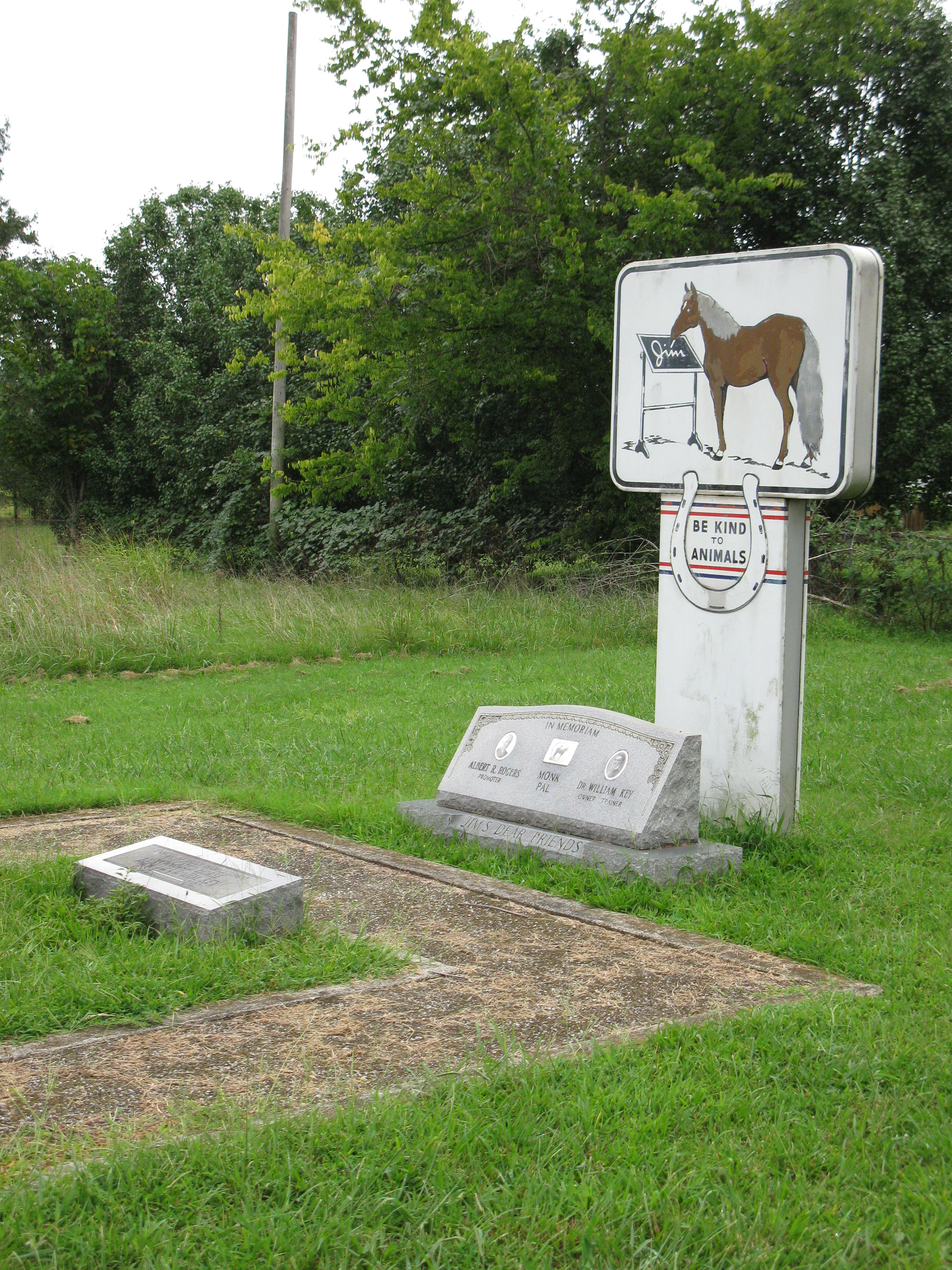
Years later, the Key land was sold, so Jim’s body was exhumed and moved to its current location, three miles south of the Shelbyville Courthouse, just north of Himesville Road, where it intersects with the Old Tullahoma Highway.
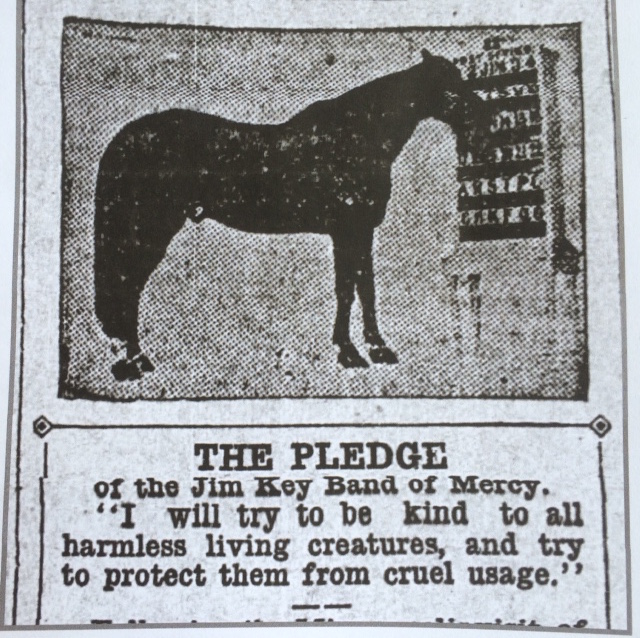
What was the original Jim Key Pledge of Kindness?
Take the updated version, the Step Right Up Kindness Pledge here.
If I could choose one surprising factoid about Doc that didn’t make it into the book, what would it be?
There are soooo many cool facts, but here’s one that intrigues me: Doc was sometimes referred to as a voodoo man because he always strung a garland of 5,000 rabbit’s feet above Jim’s stage. No doubt, this is related to cultural superstitions. Doc claimed that the rabbit’s feet came from Civil War battlefields—perhaps remnants of soldier’s cooking pots.
Stay tuned for more FAQ posts about SRU and Beautiful Jim Key. Click here to send me your burning question. You might find my response in my next post.
Click here for information about my author visits.

I had heard a movie was going to be made starring Morgan Freeman. Was that movie ever made and if so how can I purchase a copy.
Was the movie of Beautiful Jim Key story starring Morgan Freeman ever made and where could I watch it or purchase it?
I do not receive updates about movie plans, but it appears the originally-planned film starring Morgan Freeman has been shelved for now.
Incredible story! Why have we not heard of this awesome Jim Key? The world must know this fabulous history! Please let me know the updates of the movie progression. Thanks