
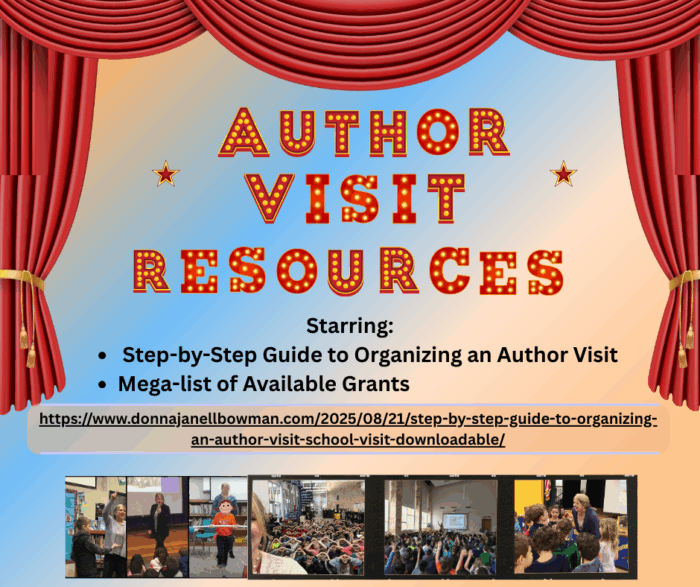
Click to download the Step-by-Step Guide to Organizing an Author visit
Click to download Donna’s school visit brochure
School author visits can be fun and enlightening, and educators around the world confirm that, after meeting an author, students are more energized to read and write. By pulling back the creative curtain, authors can open minds, hearts, and imaginations. But how do you plan for such an impactful event? Follow these fifteen steps, and you’ll be an expert in no time.
- Know what you want: Every school’s student population and objective is unique and varies by year. It’s important to consider what kind of author visit would be most beneficial. Maybe your goal is to host the author of a wildly popular book or series. Or maybe, after feedback from classroom teachers, your goal is to connect with an author who can support the curriculum in an inspiring way with nonfiction or fiction (ie: writing and revision process, research, essays, biographies, STEM, social-emotional topics, kindness, writing workshops, etc.).
Tip: If you are not the librarian or media specialist, please involve them.
- Clear the visit with the appropriate administrator: Usually, that’s the school principal, but every district and campus has a different protocol that should be followed. In addition to discussing objectives, this is the time to discuss budget limitations.
- Paying for an author visit: Speaking of budgets, funds for author visits often come from PTAs, school budgets, special fundraising efforts, benefactors, or grants. Before you reach out to authors, know how you will pay their honorarium and travel expenses.
- Identify the right author for your school: Not all authors are dynamic and kid- friendly speakers, so do your homework.
- Don’t overlook quality local authors. Less travel = less expense.
- Consider how many presentations you want: Are you aiming for a full-day visit (usually 3-4 presentations), a half-day visit (usually 2 presentations), a single presentation, or a large assembly-type visit? Virtual or in-person?
Tip: To ensure a deeper connection between the author and students, and to accommodate developmental stages, consider splitting presentations by age ranges. For example, grades K-2, 3-5, 6-8, etc.
- Identify your ideal timing: Between holidays
- , school-wide events, and state testing schedules, schools are busy, busy, busy. So are authors, who often juggle day jobs and writing deadlines with author visits. Propose a variety of date options.
- Reach out to your preferred author: Don’t be shy or nervous. Authors LOVE hearing from library champions and educators! Provide the following information in your email to avoid back-and-forth questions:
- Your date options
- Whether you’re looking for virtual or in-person presentations
- Where your school is located
- The number of presentations, and for which grades
- Any additional requests for the event day, such as a family literacy night, PTA presentation, a meal with the staff or a small student group, etc..
- If the author lists their presentation topics on their website, mention your preference or propose a customized topic.
- Ask for their honorarium, including travel expenses.
Tip: If the author’s honorarium is out of your budget, ask if there’s any wiggle room. Sometimes, authors can adjust their rates to accommodate schools. If your first-choice author doesn’t work out, thank them for their time, then move on to your next choice, or ask the author for recommendations.
Tip: Consider coordinating with other schools in your district to “share” an author on consecutive days, thereby splitting any travel expenses. Sometimes, authors will also reduce their per-school honorarium because back-to-back visits are more time-efficient for them.
- You will likely receive a contract/agreement from the author, specifying expectations and financial details. Sign and return it as soon as possible. If your district requires a specific contract, let the author know as soon as possible.
Your author visit is booked. Now what?
Yay, your author visit is booked! Notify all involved teachers and put the event on your school calendar in permanent ink. You might even want to alert your local media.
- Prepare the students and teachers: If students don’t know who the author is or what they write, they are less likely to be invested in the author’s visit. Here are some ideas for priming the student-author connection in the weeks leading up to the impending event:
- Read the author’s book(s) with the students. This makes a world of difference!
- Encourage art and craft projects, readers’ theaters or role-playing, book-inspired writing projects, fundraising efforts, letters to the author, school decorations, welcome signs for the author, etc.
- Encourage each student or each class to narrow down 2-3 questions for the author.
- Book sales (optional but encouraged): Signed books are fabulous souvenirs for students. Send pre-formatted book order forms home with students 4-6 weeks in advance. Order the books from your preferred retailer or directly from the publishers. (Note: Schools often get a discount! Also, order extra books for those late orders.)
Tip: Authors LOVE to autograph books for students, so set aside some time and watch the magic!
- Details to clarify with the author in advance:
- Most authors are fine with still photos, but you should ask permission if you or anybody else wants to record audio or video from the presentation(s).
- Virtual: If the presentations will be virtual, which platform will be used? Be sure to test it with the author the day before the event.
Logistics:
- In-person: In which room will the author’s presentations take place?
- If the author is bringing a PowerPoint-type presentation, will it be on a USB/flash drive for use on the school computer or their own? Or will it be accessed via Google Drive or Dropbox?
- Will the author use their own clicker, cords, dongles, etc.?
- Will the school provide a microphone?
- What screen will the school make available: projector, smartboard, large TV, etc?
- Will the author need a table, chair, whiteboard, paper flip chart, or anything else for their presentation?
- How much performance space will the author need in front of the audience?
11. Schedule the day: It’s important to share an itinerary with the author in advance.
- For virtual visits, they’ll need to know when and how to log in for each presentation, and which educator(s) will monitor online behavior.
- For in-person visits, they’ll need to know where to park, the times of their presentations, and whether you will be providing them lunch.
- Please allow enough time between presentations for the author to catch their breath while different student groups exit and enter. Each author will have a preference.
Tip: If the author will be visiting multiple schools over more than two consecutive days, consider creating a shareable itinerary. It can be an efficient way for librarians to coordinate logistics and times with the author. Example: Google Sheets
- The big day arrives: Let the fun, friendship, and inspiration begin! Here are some final tips for in-person visits:
- Most authors will arrive early to ensure that the technology works. Once everything’s set, get to know this wordsmith. Authors are kind and down-to-earth folks!
- Let the author know what the school’s quiet signal is for the students.
- Come up with a timekeeper agreement. It can be helpful and efficient for authors to have a five or 10-minute warning as the presentation time winds down.
- Provide water if the author doesn’t bring their own.
- Time is precious, so instruct teachers to have the students seated BEFORE each presentation’s start time.
- Require that teachers stay. Many authors incorporate curriculum that supports teacher efforts, so they need to know what the students are learning. Of course, teachers help deter behavior issues, too.
- Students will be energized to read and write after the author visit, so allow them free-writing time as soon as possible.
- At the end of your author visit day, compliment the author on what went well, and offer constructive feedback that could elevate their presentations even more. Authors always strive to improve.
- As you hand the author their payment, ask if they can recommend other authors who would be good with young audiences for next year. You might be surprised by their insight.
Bonus:
Handy-dandy list of available grants for education:
Click to download the Step-by-Step Guide to Organizing an Author visit
Click to download Donna’s school visit brochure
Congratulations, you are now ready to organize a school author visit like a pro!!
If you’d like to know about my school visits, contact me: donna@donnajanellbowman.com
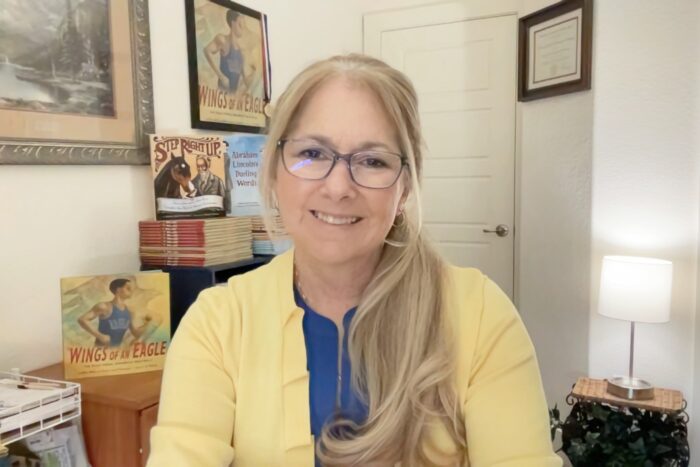 Donna Janell Bowman is an award-winning author of books for young readers, including Wings of an Eagle: The Gold Medal Dreams of Billy Mills, co-authored with Billy Mills (Oglala Lakota); Step Right Up: How Doc and Jim Key Taught the World About Kindness; Abraham Lincoln’s Dueling Words; King of the Tightrope: When the Great Blondin Ruled Niagara; and others. Donna’s books have garnered such accolades as starred reviews, state book awards, a Robert F. Sibert Award Honor from ALA, and awards and honors from NCTE, NCSS, ALSC, TLA, Oprah Daily, Library of Congress Great Reads, Best-Of-The-Year lists, and more. Armed with an MFA in Writing from Vermont College of Fine Arts, with a specialty in literature for children and young adults, she writes from her Central Texas home. She especially enjoys inspiring young readers and writers during school visits around the country. Learn more at www.donnajanellbowman.com.